

Replacing Keys on Furniture Locks
Fitting Furniture Keys
Replacing keys for an existing lock is difficult
- Knowing the manufacturer and model number of the lock unfortunately does not help in locating a replacement key. The majority of historic lock companies are no longer in business.
-
Replacing keys on existing locks is very difficult.
- The lock mechanisms are often quite complex requiring a specific cut pattern in the key bit.
- These cut-patterns are rarely interchangeable.
- A locksmith is often required to cut the exact pattern in the key for it to turn the lock mechanism.
Choosing a key blank:
Key Blanks

- Determine lock-pin diameter This measurement is critical as key-barrel must slide over lock pin.
- The key-bit must be sized correctly to move the lock-bolt .
Key-bit Patterns vary according to individual locks.
- Some locks are easily turned with a simple un-notched blade
- Other locks require a key bit cut pattern to have one notch to lock or unlock
- Many locks require a key bit cut pattern to have 2 notches: one notch locks the lock the other notch unlocks the lock
- Locks made with spring-loaded levers require very specific key bit cut pattern. The cut pattern is often complex. This type of key is typically very difficult to reproduce.
- We do-not know of or have a guide for how to determine the key bit pattern. A locksmith, who is familiar with older locks, is our best recommendation.
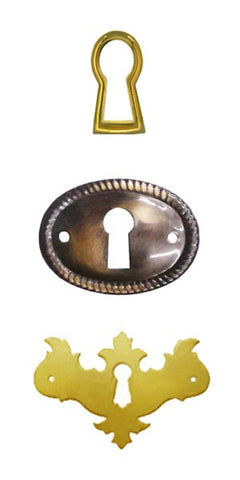
Selecting Keyhole Covers - Escutcheons
Keyhole Covers and Escutcheons
- Measure keyhole height in furniture
- Measure height of key-bit
- Compare above determined measurements, to interior keyhole measurements, of the desired keyhole cover


