
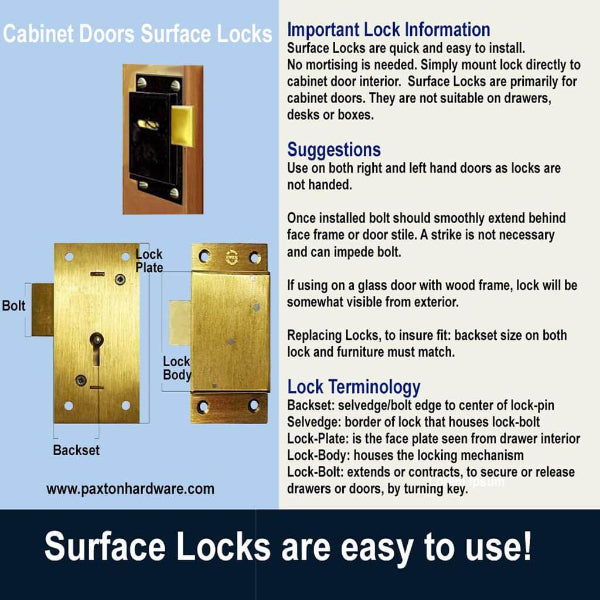
Surface Locks are a easy to install
The easiest way to secure furniture or cabinet doors without routing or mortising is to use surface locks. They mount directly to the interior of cabinet doors for instant installation. This style captures the aesthetic of 19th and early 20th century furniture while delivering straightforward, reliable security today.
Our surface locks are reversable. This means they work both right and left hand doors.
This style lock is just for doors. They cannot be used on drawers, desks lids or boxes.
Please note: these locks are visible when looking into a glass curio or china closet door. If preferred a half mortise or full mortise lock will provide a less visible alternative.
Use with a keyhole cover for a finished appearance.
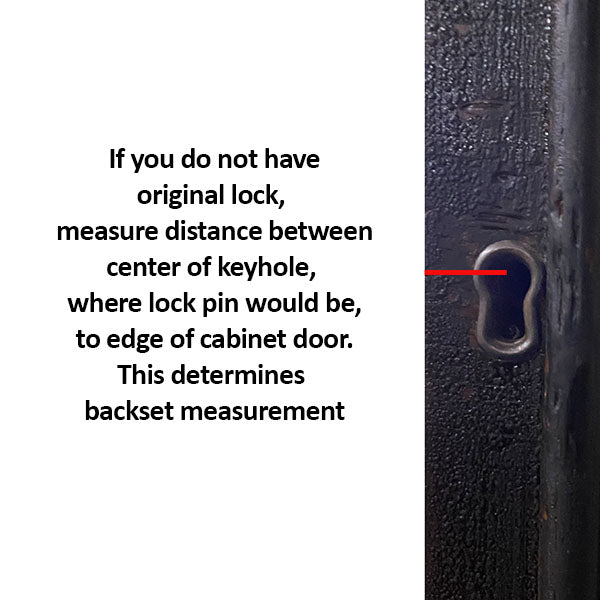
Image with text
New Construction
- Consider placement of keyhole cover on cabinet door as this could affect actual keyhole location
- Keyhole location determines required backset measurement for lock.
- Backset: distance between selvedge-edge of lock to center-of-pin in keyhole. (see diagram)
- Be sure overall size of Lock-Plate will fit onto door stile/face frame
When replacing locks:
- If you have original lock: measure distance between selvedge-edge (edge where bolt shoots through lock) to lock pin in center of keyhole. This measurement is known as the backset.
- If original lock is not available, determine backset by measuring: distance from center of keyhole to edge of cabinet door.
- The replacement lock's backset measurement must match location of keyhole in furniture.
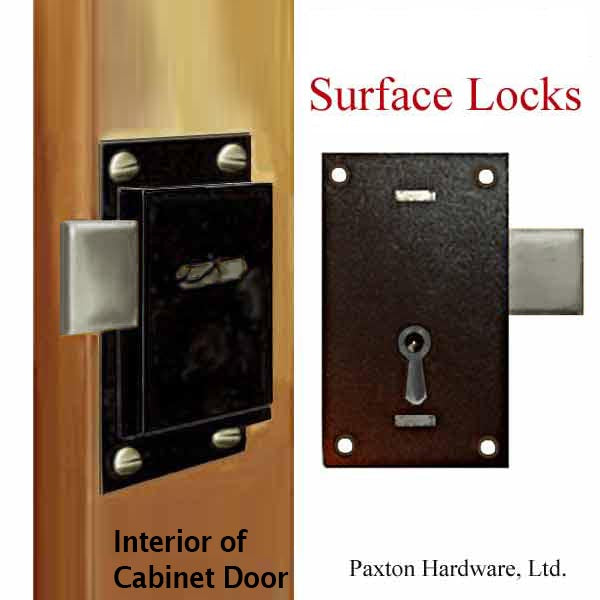
Installing Surface Locks
Surface locks are easy to install.
Locks are simply attached to inside of door frame at desired location, mortising is necessary.
A strike is not necessary and rarely used with this style lock. If one is used care must be taken when installing so that the strike does not impede the bolt from smoothly extending behind face frame or door stile.
Determine desired location of lock
- Position of lock must allow for bolt to extend behind face frame of cabinet. A minimum of ¼" is necessary to secure door when locked.
- Ideally edge of lock should line up with edge of door
- If keyhole already exists in door, make sure lock-keyhole lines up with cabinet-keyhole
Keyhole Placement
- Measure distance from top of lock-plate to center of key pin
- Measure distance from side of lock-plate to center of key pin
- With these two measurements locate keyhole on furniture front, make sure key pin is aligned with keyhole location
- Drill small pilot hole at key pin location, hold lock in position and check to make sure hole lines up with key pin
- Drill hole larger to accommodate key barrel
- Cut remaining portion of keyhole with a small keyhole saw
Mark location of lock on door interior
- Insert key from front through door into lock
- With key in position, hold lock at desired location on back of door and mark screw holes
- Drill small pilot holes for screws
Mount Lock
- Mount lock and attach with wood screws
- For a finished appearance: mount an escutcheon/keyhole plate, on door front.

